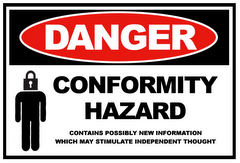
"Human beings never think for themselves, they find it too uncomfortable. For the most part, members of our species simply repeat what they are told--and become upset if they are exposed to any different view. The characteristic human trait is not awareness but conformity...Other animals fight for territory or food; but, uniquely in the animal kingdom, human beings fight for their 'beliefs'...The reason is that beliefs guide behavior, which has evolutionary importance among human beings. But at a time when our behavior may well lead us to extinction, I see no reason to assume we have any awareness at all. We are stubborn, self-destructive conformists. Any other view of our species is just a self-congratulatory delusion." - Michael Crichton, The Lost World

Tuesday, January 30, 2007

Systems - Buy Them Or Build Them?

Since we offer systems for sale one might assume that we would suggest
that systems should be purchased rather than built from scratch.
Actually we are very strong advocates of building your own system if you
are capable of doing so.

One of the reasons that we make this recommendation is that we believe
it is important that trading systems should fit the needs and
preferences of the user. A system may appear to have excellent
performance data but another trader may consider one trader's favorite
system as completely worthless. It seems that everyone has a different
level of comfort when it comes to following a particular system and the
comfort level increases dramatically if you are personally involved in
the planning and research that produces the system.

In addition to comfort levels and other psychological issues,
preferences for systems may vary because the resources of traders will
vary. For example some traders have very large amounts of capital to
work with while other may have much smaller amounts to put at risk. Due
to differences in capital or risk tolerances these traders may require
different systems. In addition to the amount of capital available there
are other resources that may influence the choice of systems. Some
traders have many hours a day available and want to trade for a living
while others have very demanding occupations and limited time to devote
to trading. Many systems traders have extensive experience with
computers and a great deal of knowledge about programming. But on the
other hand, many of us will have little knowledge and experience in this
technical field. Some systems traders have many years of actual trading
experience and others are admitted novices. Some traders have access to
the newest and most expensive hardware and prefer to receive real time
price data while many traders will find they can trade well using less
sophisticated equipment and simple end of day data.

We could continue with additional examples of important differences
among traders that might influence their preference in trading systems
but the point has been made. The advantages of building your own
trading system might be compared to the advantages of owning a tailor
made suit as opposed to buying one off the rack. If you build your own
system you can tailor it to your exact specifications so it fits your
preferences and resources.

However, just as most of us would not consider making our own clothing,
designing and testing a trading system is a task that may not be
appropriate or realistic for everyone. Assuming that you have the
necessary knowledge and resources to create your own system there are
still many obstacles to overcome. For one thing there is the
frustration of investing in equipment, software and data only to find
that most of our best ideas don't work. It would not be an exaggeration
to reveal that ninety nine percent of our research winds up in the
wastebasket. Also keep in mind the value of your time because until a
system is completed you will be working hundreds of hours for less than
minimum wages. There are no shortcuts so you had better enjoy the
entire process.

However the benefits of building the system yourself can be substantial
and we think the benefits are worth the effort. You will know and
understand the logic behind each step in the system. The knowledge
gained in the testing process should give you confidence in the system
so that you will have the necessary discipline to follow the system
correctly when it comes time to start trading it with real money. The
testing process should also give you a "feel" for the system that will
help you to sense when it is not performing as intended. If necessary
you will also have the ability to fine tune the system based on your
real time experience. We believe that over the long run the discipline
and confidence of the system operator have a great deal to with
determining the ultimate success of any system. By creating the system
yourself you are most likely to trust it and operate it correctly.

We suggest that you should seriously consider building your own systems
if you can satisfy most of the following criteria:

1. You enjoy challenges and have a knowledge of the commitment required
to excel at anything. If you have been an outstanding success at any
endeavor then you already understand commitment. In particular we
believe that success at competitive games like bridge, chess,
backgammon, poker and other pastimes requiring discipline, patience and
strategy would be a good indication that you can build a good system and
operate it successfully.

2. You own or are prepared to purchase a testing platform (like
TradeStation or something similar) and will spend the time required to
learn how to operate it.

3. You understand how to program the software you will be using or you
are willing to pay a professional programmer to assist you. If you do
not have a programming background you will find that there is nothing
easy about Omega's so-called Easy Language. If you have no programming
experience and decide to hire a programmer you should study enough about
the programming to enable you to communicate with your programmer. As a
minimum you need to be able to express your ideas in "if / then"
statements.

4. You need to have studied some basics on testing procedures and know
how to analyze and evaluate the test results. Some training in
statistical analysis would be very helpful.

5. You will need a source of clean historical data and the software to
convert the data to the format that will be used in testing. For
example you may want to convert the data to continuos back-adjusted
contracts. There are other popular formats for historical data and you
should know which format is appropriate for the testing and type of
system you will be creating.

6. You have spent some time clearly defining exactly what you want from
your system. You need to list and prioritize these desired
characteristics because they will guide your research.

7. You must have an abundance of time and patience. Picture yourself as
Thomas Edison setting out to invent the light bulb. Will you have the
commitment and patience to keep trying one element after another to find
the one that works? (As an example, we have been working on S&P trading
systems for years and we have yet to come up with one that we would be
willing to trade. We are still trying.)

8. Can you be truthful with yourself and analyze your test results
without letting your natural optimism cloud your judgment. (However, if
you are not an optimist you are automatically disqualified.)


Chuck Lebeau is the co-author of Computer Analysis of the Futures Market, and the former co-editor of Technical Traders Bulletin. Chuck is currently operates a website devoted to trading topics; www.traderclub.com.

Friday, January 26, 2007

Measuring Exit Efficiency

Those of you who have read our book and followed our work over the years will quickly recognize that we have long been outspoken advocates of the importance of good exits. In our opinion exits are much more important than entries yet the majority of new traders spend most of their time seeking the ideal entry strategy as if this would solve all of their problems.

In the
System Building workshops that I teach with Dr. Tharp, we play an exit game where everyone enters a series of trades at the same point and then implements their own exit strategy as prices are reported to the group. After about ten quick trials of this game the results typically range from one extreme to the other. A few traders make a lot of money, a few lose a lot of money and most fall somewhere in between. It would be rare for any two players to have the same results. The point of this simple exercise is to illustrate the effect of exits on our trading results. Everyone has identical entries yet the outcome of the simulated trading always ranges from big losses to big profits.

The same is true in actual trading. Exits determine the outcome of our trading and have more impact on the results than any other factor. Yes, exits are even more important than money management (position sizing). Not even the best money management strategy can make a losing system into a winner but a minor change in the exit strategy can work miracles. We quickly discovered this years ago when attempting our first tests of indicators. We found that even a slight variation of the exit strategy used in the testing would affect the number of trades, the size of the winners and losers, the percentage of winners, the drawdown and the total profitability. We set out to test entries but quickly learned that in most cases we were testing exits because the entries had little if anything to do with the results.

We eventually began isolating, as best we could, our testing of entries and exits. We now test entries based solely on the percentage of winning trades, exiting after a specified number of bars. This method of testing entries is based on our conclusion that the only purpose of entry timing is to get the trade started in the right direction as accurately as possible. Everything that happens after that has nothing to do with the entry because the outcome of the trade is now in the hands of our exit strategies. We want our entries to accomplish only one purpose and that is to get our trades started in the right direction as quickly as possible and this function is easy to measure. The higher the winning percentage after a few bars the better the entry. But how do we measure the efficiency of our exits? How can we tell if one exit is better than another? What is a good exit? What is a bad exit? Which is better: exit A or exit B?

To try and quantify the relative merit of various exits we created the Exit Efficiency Ratio and contributed an article on this topic to Futures Magazine several years ago. (I'm trying to get this Bulletin out today and I am sorry that I don't have the specific reference for the article in front of me. I'll find it and post it on the FORUM page.)

For those of you using Rina/Omega's Portfolio Maximizer software you should be aware that the Exit Efficiency Ratio that we wrote about is not the same calculation presently used in Portfolio Maximizer. Here is our original version of the Exit Efficiency Ratio.

You need to start by keeping or creating a record of your winning trades. You must also keep a record of the total number of bars in the trade from entry to exit. As an example, lets assume that we made a profitable trade that lasted 12 bars from entry to exit and the trade captured $1500 of gross profit.

The next step is to go back and look at our entry point and 24 bars of data after our entry. Our theoretical holding period is now twice the actual holding period. We then use perfect hindsight to identify the best possible exit point within this theoretical holding period. Don't be shy, pick the absolute best tick for the theoretical exit and compute the theoretical gross profit. In this case lets assume that somewhere in the period we could have exited the trade with a $2500 profit at the absolute high point of the theoretical trade.

The Exit Efficiency Ratio is then calculated by dividing the actual gross profit by the theoretical gross profit. We divide 1500 by 2500 to arrive at an Exit Efficiency Ratio of 60%. This tells us that we actually captured 60% of the profit that might have been possible for this trade.

The Portfolio Maximizer formula for exit efficiency measures only the efficiency during the actual holding period. I'm sure this is for practical reasons because the trade by trade listing used for most calculations would not include data outside the range of the holding period.

When calculating the best theoretical exit point, the doubling of the holding period is critical to evaluating the exit fairly because most traders err on the side of exiting their profitable trades much too soon. By extending the theoretical holding period beyond the actual exit bar we can see if this was the case. In our example we exited the actual trade after 12 bars and lets assume that the ideal exit point was on the 20th bar. If we only measured the bars in the actual trade our ideal exit point might have been on the 12th bar where we closed out our trade just as we were climbing to a new peak. Measuring only the duration of the actual trade would credit us with an exit that was 100% efficient. The tendency of any calculation based only on the bars during the trade would be to reward us for exits prior to the peak and to penalize you for exits after the peak that might have been more profitable than the earlier exit. By doubling the holding period in our theoretical calculation of the ideal exit point we can easily see if we closed out any of our trades too soon.

We typically use a combination of exit strategies and by giving each of our exits a name we can evaluate our exits individually or as a complete exit package. Some exits (like the Yo Yo exit) score better than others but since this can not be the only exit in a system we must evaluate the combination of exits as well as each individual exit.


Chuck Lebeau is the co-author of Computer Analysis of the Futures Market, and the former co-editor of Technical Traders Bulletin. Chuck is currently operates a website devoted to trading topics; www.traderclub.com.

Twenty Questions

Gamblers Anonymous offers the following questions to anyone who may have a gambling problem. These questions are provided to help the individual decide if he or she is a compulsive gambler and wants to stop gambling.

TWENTY QUESTIONS

  1. Did you ever lose time from work or school due to gambling?
  2. Has gambling ever made your home life unhappy?
  3. Did gambling affect your reputation?
  4. Have you ever felt remorse after gambling?
  5. Did you ever gamble to get money with which to pay debts or otherwise solve financial difficulties?
  6. Did gambling cause a decrease in your ambition or efficiency?
  7. After losing did you feel you must return as soon as possible and win back your losses?
  8. After a win did you have a strong urge to return and win more?
  9. Did you often gamble until your last dollar was gone?
  10. Did you ever borrow to finance your gambling?
  11. Have you ever sold anything to finance gambling?
  12. Were you reluctant to use "gambling money" for normal expenditures?
  13. Did gambling make you careless of the welfare of yourself or your family?
  14. Did you ever gamble longer than you had planned?
  15. Have you ever gambled to escape worry or trouble?
  16. Have you ever committed, or considered committing, an illegal act to finance gambling?
  17. Did gambling cause you to have difficulty in sleeping?
  18. Do arguments, disappointments or frustrations create within you an urge to gamble?
  19. Did you ever have an urge to celebrate any good fortune by a few hours of gambling?
  20. Have you ever considered self destruction or suicide as a result of your gambling?


Most compulsive gamblers will answer yes to at least seven of these questions.

Traders Anonymous offers the following questions to anyone who may have a trading problem. These questions are provided to help the individual decide if he or she is a compulsive trader and wants to stop trading.

TWENTY QUESTIONS

  1. Did you ever lose time from work or school due to trading?
  2. Has trading ever made your home life unhappy?
  3. Did trading affect your reputation?
  4. Have you ever felt remorse after trading?
  5. Did you ever trading to get money with which to pay debts or otherwise solve financial difficulties?
  6. Did trading cause a decrease in your ambition or efficiency?
  7. After losing did you feel you must return as soon as possible and win back your losses?
  8. After a win did you have a strong urge to return and win more?
  9. Did you often trade until your last dollar was gone?
  10. Did you ever borrow to finance your trading?
  11. Have you ever sold anything to finance trading?
  12. Were you reluctant to use "trading money" for normal expenditures?
  13. Did trading make you careless of the welfare of yourself or your family?
  14. Did you ever trade longer than you had planned?
  15. Have you ever traded to escape worry or trouble?
  16. Have you ever committed, or considered committing, an illegal act to finance trading?
  17. Did trading cause you to have difficulty in sleeping?
  18. Do arguments, disappointments or frustrations create within you an urge to trade?
  19. Did you ever have an urge to celebrate any good fortune by a few hours of trading?
  20. Have you ever considered self destruction or suicide as a result of your trading?

Most compulsive traders will answer yes to at least seven of these questions.

Tuesday, January 23, 2007

Expectancy

Las Vegas. Great food, show girls, and a multi-billion dollar gambling business. The money made by the casinos is only matched by the profits on Wall Street. And the profits of both are based on mathematical probabilities.

Casinos make money because “the odds” or a game’s expectancy are in the house‘s favor. This means that if you play long enough, the casino wins. Over the short term, the casino knows it may win or lose. But if you play long enough, the house always wins. The casinos increase their profits by offering games that are completed in a short period of time – a roll of dice, a spin of a wheel or a few cards turned over.


What does this have to do with trading systems?

  • We want the odds of a trade to favor us – expectancy
  • We want a lot of trades – opportunity
  • We want turn over so we can compound the profits – holding time.

What we as traders must do is become the house. The odds in our trading must favor us, we need a reasonable number of trades during the year and the trades must be completed in a reasonable amount of time for compounding to be effective.

Expectancy is simply the product of your profit percentage per win and your win rate minus the product of your loss percentage per loss and your loss rate. For example:

  • Win percentage 6%
  • Win rate 60%
  • Loss percentage 4%
  • Loss rate 40%.

The expectancy is 2.0% per trade, or (6% x 60%) - (4% x 40%).

That means, on an average trade, 2% of the money traded is yours to keep. That’s better odds than a casino gets on blackjack. Now, that may not sound like a lot of money. If your average trade is $10,000 – 2% is $200 profit per trade. If you have 300 trades per year, then you have a $60,000 profit per year with an average trade of only $10,000. This does not even include the profits if you compounded the average trade.

If you explore the expectancy formula, you will notice that there is no one set of numbers that could give a positive expectancy but an infinite number of sets and therefore an infinite number of trading systems that could be profitable.

Given that, it is possible to develop systems where the stop loss is larger than the profits. The stop loss is academic, as long as your profit expectancy is positive.

Here’s another example: we could use a 20% stop loss and a 5% profit target and come out with the same exact 2% expectancy as long as my win rate is high enough! An 88% win rate in this example would yield 2.0%, the result of (5% x 88%) - (20% x 12%).

Or, you could arrive at a positive expectancy with a very low win rate. One of the more famous expectancy numbers comes from William O’Neil, advocate of the CANSLIM system and founder of Investors Business Daily. If we use his stop and target numbers of 8% and 20% and his published win rate of 30%, the expectancy can be calculated to be: (20% x 30%) - (8% x 70%) or +0.4%.

The bottom line is: expectancy must be positive if you want to make a profit over time. Never use a system with a zero or negative expectancy. You will not win. You can not beat the house over a long series of bets or trades. Be the “House”.

No matter what your expectancy is, you will not make a great deal of money unless you have a lot of opportunities to trade. Again, the casino analogy. The casino may only make 1-2% per hand of blackjack, but they turn over those hands very quickly – 30 to 40 hands per hour. Play blackjack long enough and you will lose over 40% of your money per hour! No wonder they can offer those wonderful comps.

We now know how to create a method, at least on paper, with a positive expectancy. Let’s say we develop a system with 8% expectancy, but if the system only yielded one trade per year, what good would it be? We might as well just put the money in a savings account. Or, if we had a method that yielded 0.2% per trade, you might pass on it? But what if that system generated 1,000 trades per year? 1,000 times 0.2% becomes serious money in a very short time.

The most overlooked area of trading is the "holding period." In order to make money, you must have a system that generates a positive expectancy and a lot of opportunities. But you must have access to your money. If your trade’s hold time is too long, you can't take advantage of all or even most of your opportunities. Your trading money or buying power is always tied up because you have to wait too long to close your trades.

Casino analogy time. If the house odds in Blackjack are 2.5%, that means for ever $2 bet, the casino makes, on average, 5 cents. If you only play 1 game per hour, the casino makes 5 cents per hour. If you play 60 games per hour, the casino has all of your $2 in 40 minutes. All things being equal, the game with the fastest turnover is the more profitable for the casino.

It's no different with trading. You will be more profitable with $100,000 that you could "turn" 250 times per year, than $500,000 that was tied up in one trade for 12 months. As an example, let's say we have one trade and that trade yielded a 50% return. You just had a great year - a $250,000 profit.

On the other hand, say you had $100,000 for stock purchases, and your expectancy was only 1.2% per trade but you turned over your stocks 250 times in the same year. This method ends up generating $300,000 for the year, and that assumes you never increase the position size as the equity grows. You just had a better year. And it is easier to get 1.2% per trade than 50%.

The bottom line for a great bottom line is:

  • A positive expectancy
  • A good number of trades
  • A short holding period

Source: www.arbtrading.com

I Read the News Today, Oh Boy

Consider the following three news headlines:

  • The CEO of Company XYZ has just resigned
  • The markets were down today due to profit taking
  • The FED will raise interest rates at the next FOMC meeting.


All of them are typically grouped under the heading ‘news’, but actually only one of them is of any use to a trader. Each of these news items belongs to one of the 3 kinds of financial news. These are:

Facts - something that has happened or is scheduled to happen in the future
Explanations – an attempt to identify a cause and effect relationship
Predictions – a forecast or guess

In trading, explanations after the event or predictions serve no useful purpose in making money. They are ‘old news’ at best, or simply incorrect or misleading. The only thing that you should pay attention to is the facts, and even then you should understand that they are mainly a lagging indicator that is difficult to trade.

Unless you have very fast news feed there is always a slew of market participants that have seen (and acted on) the news before you even click the refresh button on your browser. As ever in trading, if your edge depends on you being the fastest at something then you are unlikely to succeed in the long run. If you must create a trading system or method that uses the news as an input, make sure that you only use the factual news items, and that your system does not require you to be the ‘first to act’ in order to make money.


Paul King
PMKing Trading LLC
www.pmkingtrading.com